Showing posts with label cloud painting. Show all posts

Wednesday, 16 August 2017

A Week at Dedham Hall

It is always a pleasure to teach at Dedham Hall in Suffolk. I often get people coming back and over the years many of the students have become friends. This year I had 10 lovely students. Two had never been to Dedham before but very soon fitted in the routine.
We start on Saturday afternoon with a cup of tea and some of Wendy's delicious cake at 4pm when we all introduce ourselves and I have a quick chat about the week to come.
On the first evening I always give a talk and demo in the studio.

Clouds at Blakeney, demo. 14" x 16"


Sunday is always busy in town so we stay in the grounds of the hall, there is so much to paint there one really needn't venture further afield. I started everyone off with a quick demo of the glasshouse

Glasshouse at Dedham Hall  8" x 8"

Monday we took advantage of the good weather and went to Woodbridge. It's been a few years since I took a group there. I'd forgotten how good it was. I did a painting while I was waiting for the group to look around and decide what they wanted to paint. The tide was out but coming in fast, by the time I'd finished 1/2 hour later there was no mud to be seen.

Woodbridge 14" x 16"

I planned to go to Pin Mill so that evening I gave a demo on painting the barges which I hoped we would see there.

Barges at Pin Mill 14" x 10"


Demo at Pin Mill


I don't get much chance to do my own painting at Dedham so I often will go into the studio before breakfast. here are two of the paintings that I got up early to paint.

Cherries and Imari bowl 8" x 8"


Quimper jug and Asters with Satsumas 8" x 8"

The weather turned on us a bit on Tuesday so we went to the river to paint before rain set in. Most managed to get at least some sketching done. I got a quick demo of the cows before they disappeared


and then they were gone!!


Study in White 12" x 12"

Another evening I gave the above as a demo to illustrate light against dark in a still life. I thoroughly enjoyed painting this in spite of all those ellipses I had to deal with.

The week seemed to pass very quickly and all too soon it was time to clear the studio and set up the final exhibition. I like to take time and care over this , to display the students work at it's best. There certainly was some good work done. At 6.30 Jim & Wendy come over with drinks for out little PV and after dinner we all head back into the studio where I go round each persons work and give a constructive appraisal. This for me is the hardest bit as I try to be encouraging yet honest without upsetting anyone - so far I think I have got away with it . We'll see if they come back again next year!!

Tuesday, 18 July 2017

Thursday, 13 July 2017

Morston Group

Every year for the past 12 years the Sheringham Art group have hired the village Hall at Morston in Norfolk for me to run a two day workshop for them. In the early days we would have 15 artists attending but due to ill health of many members, numbers have dwindled so this was to be the last year.

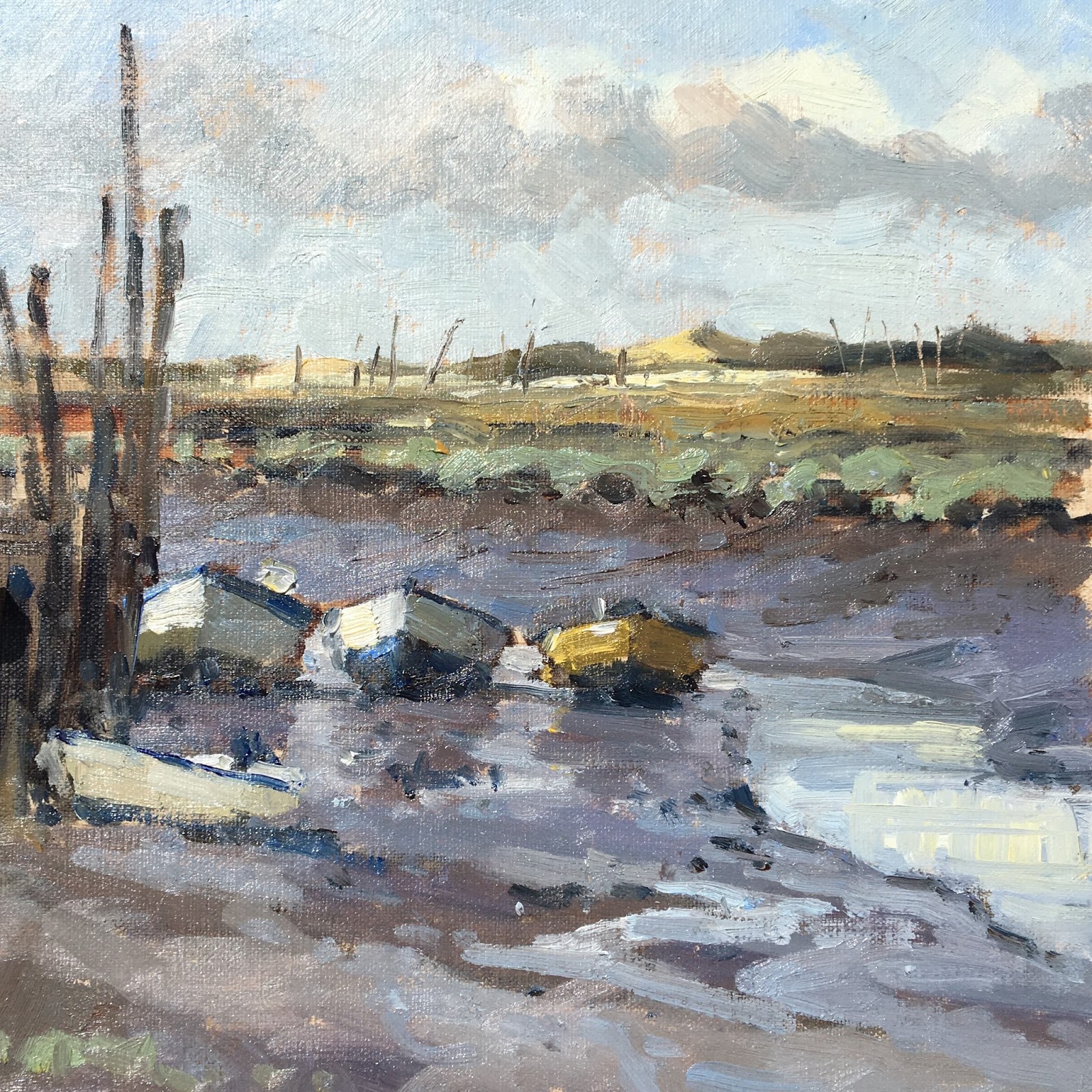
High Tide, Morston


I always start off with a demo to get people in the mood, I try to get people working on the quayside to paint but most prefer to remain in the Hall. I managed to get down there for a bit myself first and it was a beautiful high tide.

Low Tide, Morston

I have enjoyed teaching and getting to know this group and will miss them. I have decided to hire the hall myself for the same period next year and to invite artists to join me with the emphasis on Plein Air

Thursday, 16 February 2017

Demo of Using The Zorn Pallet

River at Dedham Painted using the Zorn pallet


Zorn Pallet Demo painting
The Zorn palette is named after internationally successful artist Anders Zorn  (1860 – 1920). He is well known for using a palette of only four colours
Yellow Ochre
Cadmium Red
Black
White

There has been a lot of debate as to which Black Zorn used but it is believed to be Ivory Black, which is the colour I used for the painting ‘Zorn Palette demo’. Ivory Black works well as a blue but possibly even better is Winsor & Newton’s Blue Black. Blue Black is a colour I recently discovered and use a lot in my sky paintings now.
It is possible that the red may have been Vermillion; you could try this as an alternative. The white I used was Titanium white but back in Anders Zorn’s time it is more than likely to have been Lead White.
It might at first strike you as an odd selection but the main three colours are just the earthy equivalents of the three primary colours Black being the blue.

cropped sketch

 I was working from a photograph that I took in Dedham last year. Having drawn the sketch I decided that it would be a better composition if it were cropped to a square.

stage 1

First sketch in the main lines with black and red diluted with turps.
 

stage 3

 Mix the dark cloud colour starting with white and adding black until you have the tone you want. Make sure you mix plenty and then split it, add a little red to one part and then a touch of yellow to another and some with both. This will give a variety of hues within the cloud.
For the blue-sky area, start with white and add a little black. It may not look blue on your pallet but on the canvas next to the other colours it will, you may even want to add some yellow to take the colour down a bit.


Make sure your brush is clean when you mix the light colour near the horizon with white, yellow and a touch of red. The colour here needs to be fresh.
The distant trees are a mix of white, black and yellow; they need to be dark enough to register against the sky but not too dark that they jump forward. In front of these the distant fields are white with a small amount of yellow.
It is very important to make sure there is no trace of white in your brush when you mix the colour for the dark trees. Even a trace left in the brush will make your colour ‘milky’. Painting in the reflections at the same time. The water should reflect the sky colours; paint this around your reflections. The meadow area is yellow with varying amounts of black and, in some places, red added.